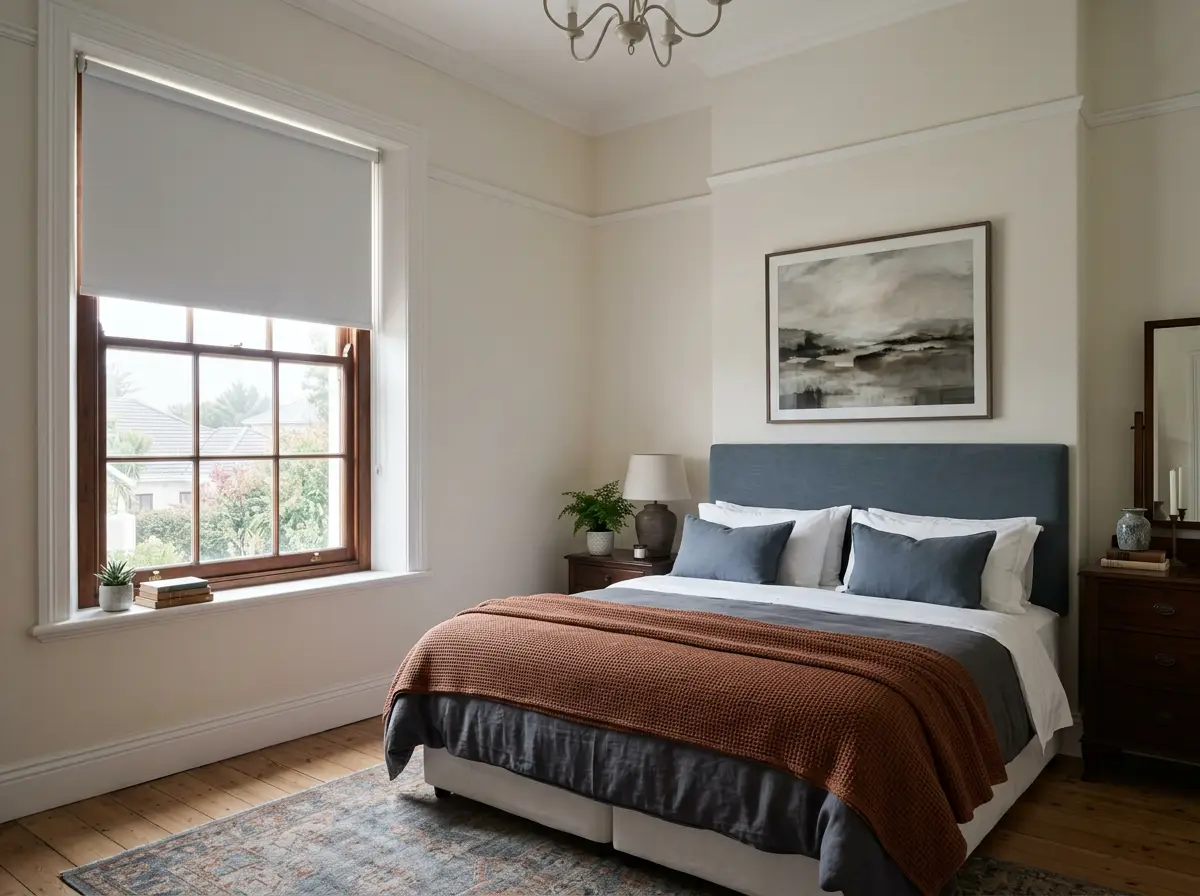
A roller blind is a simple thing. A Welgemoed window isn't.
Tube, fabric, bracket — that's the whole product. Which is exactly why everything that matters gets decided before it's made: the weave, the openness, the mount, the width. Decided well, for the window it's actually going on, it's the blind you stop noticing. That's the job.
Half-drawn is the honest test of a roller blind — a straight hem, an even roll, no light leaking past a skimped measurement.
We hang more rollers in Welgemoed than everything else put together. Not because they're fashionable — because on a slope where nearly every living room points its biggest glass at the view, a flat fabric panel that can be tuned window-by-window is simply the most adaptable tool there is.
So instead of a catalogue of options, here's how we actually think a roller through, in the order the decisions get made.
First question: what happens at four o'clock?
Every west- and north-west window up here has the same appointment each summer afternoon. Around 16:00 the sun drops low enough to come in sideways — under the eaves, straight at eye level, hard across the television. Bare glass cooks the room; a blockout fixes the glare and deletes the outlook you bought the house for. The roller's answer is the sunscreen weave, and picking it comes down to one number.
The openness number, decoded
Sunscreen mesh is graded by openness — the share of the weave that's actually hole. Three percent is the glare-killer: the room goes calm, the view softens to a muted picture, and it's what we reach for on the truly punished western glass. Five percent is the everyday compromise most Welgemoed lounges land on — noticeably more view, still enough sun control for glass that gets an hour or two of low sun rather than four. Ten percent keeps the panorama almost intact and suits windows that catch brightness rather than direct fire.
One honesty note, and it applies to every openness: mesh privacy works in daylight only. After dark, with lamps on inside and the garden black, the effect flips and the lit room becomes the visible side. Any window that's overlooked at night needs a solid layer as well — which is where the next section comes in.
When one tube isn't enough
A double roller carries two fabrics on one compact bracket — sunscreen for the day, blockout for the night — and it earns its keep in exactly two Welgemoed situations. Bedrooms with a view worth waking up to, where east light comes in hard at sunrise but nobody wants a permanently dark room. And overlooked living-room glass, where the mesh does the daytime work and the blockout answers the after-dark privacy flip. Everywhere else, one well-chosen fabric is the better spend.
What the measure settles
The last decisions are physical, and they're the reason we won't quote off a phone photo. Whether the blind sits inside the reveal (neater) or face-fixed above it (better coverage) hinges on the recess depth — and the deep reveals of Welgemoed's established houses behave completely differently to the shallow plaster returns of the new builds. A cassette pelmet can be colour-matched to the frames so the tube vanishes. Chains get a wall tensioner fitted as standard, cordless and motorised do away with the chain altogether, and anything much past three metres of fabric width becomes a linked, motorised pair rather than one straining tube — a regular conversation on this suburb's wide sliders.
What a roller blind costs here
Rollers are quoted per square metre, installed, and the fabric and the control decide the figure rather than the postcode. Manual, on a chain or a spring, in sunscreen, blockout or a light-filtering weave: R1,000 to R1,600 the square metre. Motorised, the same opening runs R2,500 to R3,800 — and on the wide sliders this suburb is full of, a linked motorised pair is often the sensible answer anyway.
A small window is charged at a minimum rather than by its area, because the tube, brackets and fitting visit are the same work whatever the width. Those are planning bands, not a quotation: your own per-window figures come out of the free measure and are put in writing before anything is cut.
How wide can a single roller blind actually go?
Most fabrics run happily to around three metres in one drop. Past that the tube starts to deflect and the fabric can wander on the roll, so we'd split the opening into a linked pair — usually motorised so both halves move as one — with a slim join line where a mullion or frame already breaks the glass.
Will a sunscreen roller stop my furniture fading?
It makes a real difference — the mesh intercepts most of the UV that does the damage, which matters under a Cape summer sun that spends whole months in the extreme band. It's a reduction, not immunity: a couch parked in direct low western sun for years will still age faster than one out of the line of fire.
Inside the recess or on the wall — what suits an older Welgemoed house?
The established homes here often have generous reveals that swallow a blind beautifully — inside-mount looks built-in and shows off the joinery. But handles, stays and burglar bars steal that depth fast. Where they intrude, face-fixing above the opening with a slightly oversized blind covers cleaner and can make the window read larger. It's a millimetres call, made with a tape measure on site.
The same measure-first approach travels across the northern slopes — Plattekloof, Durbanville, Kanonberg and the Durbanville Hills estates all sit within our normal rounds.