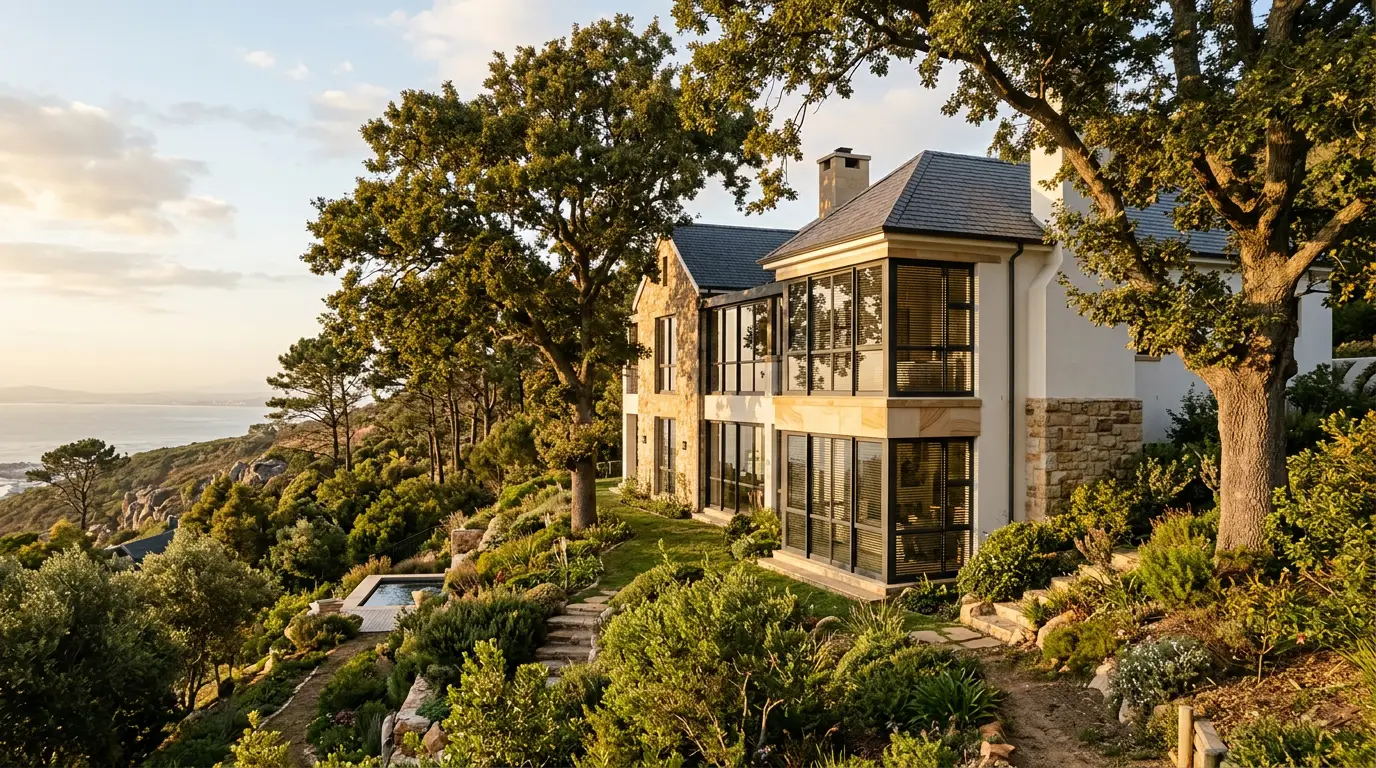
Venetian blinds for a slope that changes light all day
A roller is open or closed by degrees; a venetian steers light direction — tilt up for glare-free daylight, tilt down for privacy, close flat for dark. On a hillside like Welgemoed's, that adjustability is the whole argument.
A Welgemoed manor home, dressed for hour-by-hour light on the slope.
Welgemoed's stands sit on a slope, which means the sun's angle through a given window can change dramatically between morning and late afternoon — and a double-storey neighbour or a passing car on the road above can see straight into a downstairs room a roller blind would have to close fully to block. A venetian answers both problems without ever going fully dark.
Aluminium venetians
Slats in 25mm (crisp, most popular) or 50mm (bolder, fewer lines). The moisture champions — bathrooms, kitchens, laundries, anywhere fabric eventually fails. Powder-coated aluminium copes well with the Cape's wet winters, and the colour range including woodlook finishes covers most manor-facade palettes at a budget-friendly price point.
Timber & bamboo venetians
50mm basswood or bamboo slats bring warmth and an architectural finish that suits Welgemoed's more traditional manor rooms, sash-style windows and studies. Keep timber out of high-steam rooms; a quality lacquer finish handles normal humidity without issue. Very wide windows need splitting or ladder-tape support, since timber runs heavier than aluminium.
The adjustability argument
Tilt up for daylight without glare on a bright Welgemoed morning, tilt down for privacy from a neighbour's upper storey in the afternoon, close flat for full dark at night — all from the same blind. On a hillside suburb with genuinely different light through the day, that's not a luxury feature, it's the practical reason a venetian often wins over a roller in the rooms that need it.
What a venetian costs, by material
The material sets the band, and both are quoted per square metre installed. Aluminium, in 25 mm or 50 mm slats, comes to R1,000 to R1,500 with a wand or cord and R2,500 to R3,600 once it is motorised. Timber runs R1,600 to R2,600 manual and R3,000 to R4,500 motorised, with wider slats and stained finishes sitting at the top of both.
A narrow window carries a minimum charge, since a scullery pane still needs its own headrail, brackets and fitting visit. And a deep reveal changes how the blind is mounted rather than the rate per square metre, which is another reason the price per window is settled on site and confirmed in writing.
Fitting venetian blinds wherever a slope changes the light through the day — Plattekloof's ridge, Kanonberg's estate homes, and the established and newer streets of Durbanville and the Durbanville Hills estates.